

Rethinking Fitness in Midlife: Why Strength Training Is Your New Superpower
By Michele | Certified Menopause Coach, Girls Gone Strong
Strength training for women over 50 is not the same conversation it was a decade ago — and that's a good thing. The science has caught up with what many women already intuitively know: that building strength in midlife is one of the most protective, empowering, and metabolically important things you can do for your body and your future. For years, many of us were taught a simple formula for health: eat less, do more cardio. We logged miles on the treadmill and attended countless aerobics classes, believing that a good sweat session was the ultimate key to a healthy body.
But as you move into perimenopause and menopause, you may have noticed the old rules no longer seem to apply. Despite your best efforts, your body composition is changing, your usual workouts feel less effective, and the number on the scale may creep up anyway.
That shift can feel confusing (even a little unfair) but it’s not a sign that you’re doing anything wrong. It’s your biology changing chapters. The hormonal landscape that used to quietly support your muscles, metabolism, and bones is rewriting itself, and your movement strategy has to evolve with it.
Cardio still has a beautiful role to play for your heart, mood, and stress. But in midlife, strength training steps into the spotlight. It’s no longer a “nice-to-have.” It’s one of the most essential forms of movement for building a strong, metabolically active, and resilient body that can carry you vibrantly through the decades ahead.
📚Want the full picture of what’s changing? Explore our guide to the perimenopause transition for a deeper look at hormones, symptoms, and next steps.
Menopause and Muscle Loss: The Quiet Shift No One Warned You About
The connection between menopause and muscle loss is one of the most important (and least discussed) aspects of midlife health. Understanding it changes everything about how you approach movement, nutrition, and recovery in this chapter of your life..
For most of our lives, fitness culture taught us to shrink: smaller meals, smaller jeans, smaller presence.
We were told to jog, to “burn it off,” to count every calorie and every step.
But perimenopause and menopause change the rules in ways that are deeply physiological:
With age and hormonal change, women naturally start to lose muscle mass — a process called sarcopenia in women that accelerates significantly around the menopausal transition as estrogen levels decline. This isn't inevitable, but it does require deliberate, consistent action to counteract.
Less muscle means a slower resting metabolism and a tendency to store more fat, especially around the abdomen, even if your weight and habits haven’t changed dramatically.
At the same time, bone density starts to drop more quickly after menopause, increasing the risk of osteoporosis and fractures in later life.
Traditional “more cardio, less food” doesn’t fully address those core shifts in muscle mass, metabolism, and bone density.
That’s where strength training becomes something much bigger than just “working out.” It becomes architecture. Insurance. Future-you care.
📚For more on weight and body composition changes, explore our page on weight changes in menopause and how to support your metabolism with compassion.
Muscle: Your Midlife Power Organ
Think of muscle less as “tone” and more as metabolic real estate.
Muscle tissue helps your body manage blood sugar more efficiently.
It burns more energy at rest than fat tissue.
It supports balance, posture, and the everyday rituals of your life: carrying groceries, climbing stairs, lifting grandbabies someday.
As estrogen declines, your body becomes a bit more resistant to building and maintaining muscle. You may notice that the same workout you did at 35 simply maintains the status quo at 50. That’s not stubbornness; it’s physiology asking for a clearer, louder signal.
Strength training is that signal.
When you pick up something genuinely challenging such as weights, resistance bands, your own bodyweight in a new wa, you’re telling your muscles:
“I still need you. Adapt. Stay.”
This is the heart of midlife fitness: not chasing “smaller,” but preserving and building capacity so you can keep doing what you love.
💡 Fuel your muscle — starting tomorrow morning. One of the most impactful things you can do alongside strength training is anchor your morning with 20–30g of protein within 60 minutes of waking. It preserves muscle, steadies blood sugar, and reduces the cortisol that works against your training results. This is the Morning Anchor — Stabilizer 1 in our free Find Your Cool 3-Day Reset.
Three days. Four stabilizers. A foundation your training can actually build on. [Download the Free Reset →]
Osteoporosis Prevention in Menopause: Bones, Density, and the Life You Want at 80
Osteoporosis prevention during and after menopause is one of the most compelling reasons to prioritize strength training - and another topic not talked about enough. Most women don't think about bone density until a DEXA scan surprises them. Always discuss bone health and osteoporosis screening with your healthcare provider, particularly if you have risk factors.
Strength training is your most powerful preventive tool, and the time to start is now.
There’s a phrase in sports science: “Bones are listening.”
They listen to impact, to load, to gravity. When you stress them (safely), they respond by reinforcing their structure.
After menopause, when estrogen’s protection fades, bone starts to thin more quickly. That’s why hip, wrist, and spine fractures become more common with age. This is also why so many women are surprised by a DEXA scan that suddenly puts them in “osteopenia” or “osteoporosis” territory.
Strength training, especially with some real load, sends an essential message to your skeleton:
“We’re still climbing, still lifting, still moving through the world. Stay strong for this.”
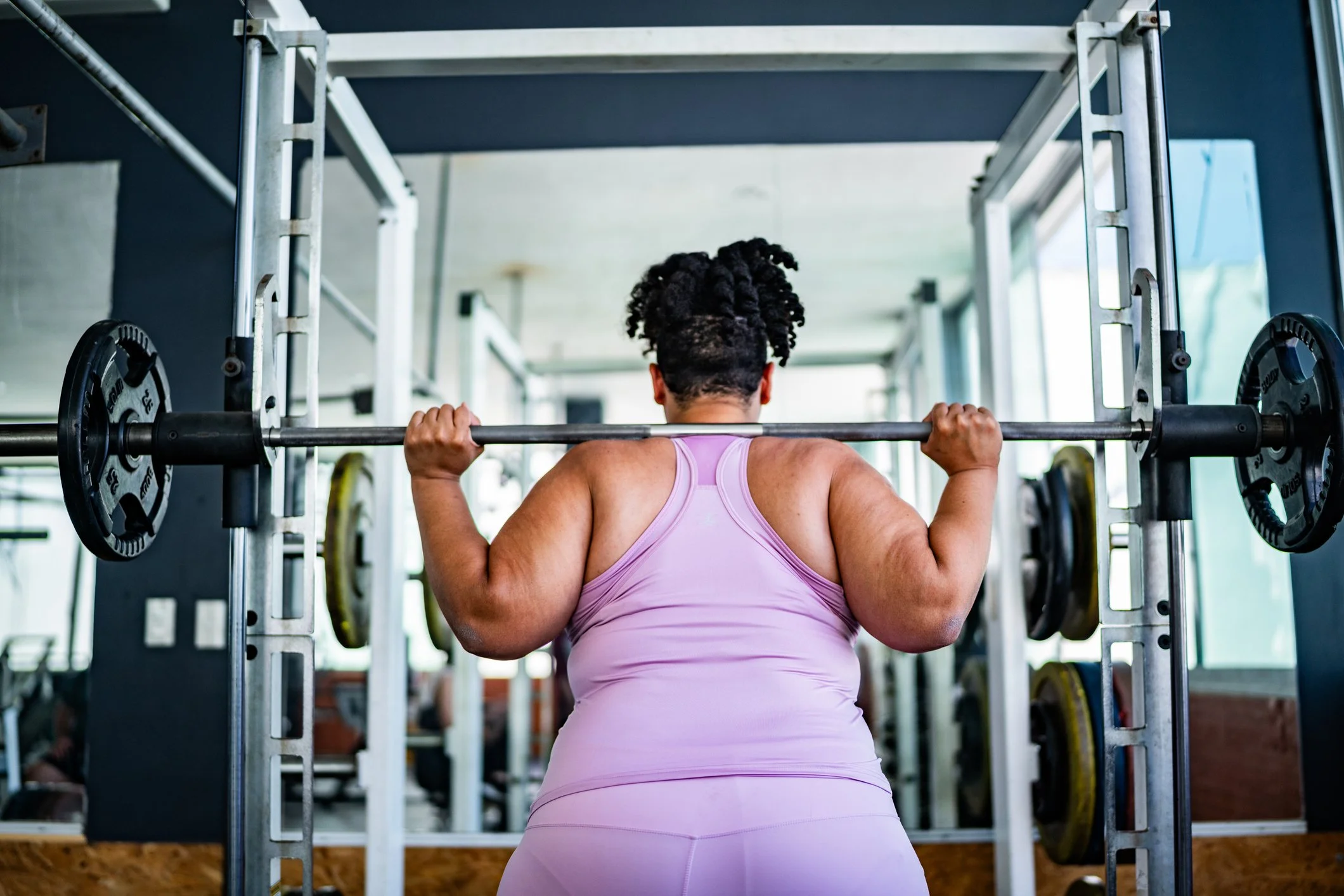
Movements like squats, deadlifts, step-ups, and overhead presses that are done in an intelligent, progressive way, can help support bone density and resilience over time. You’re not training just for this year’s vacation photos; you’re training to be able to:
Get up off the floor without help.
Travel comfortably.
Live in your own home independently for as long as possible.
That’s the real luxury.
From Shrinking to Taking Up Space
There’s also a quiet emotional revolution happening here.
Strength training in midlife isn’t only about muscle fibers and mitochondrial function. It’s about permission to take up space.
For decades, many women have been praised for being small: small appetite, small voice, small presence at the table.
Walking into a weight area (whether that’s your living room with a pair of dumbbells or a gym) and saying “I’m here to get stronger” is a profound mindset shift. It’s declaring that your midlife body is not a problem to be fixed, but a home to be fortified.
The strength training benefits for menopause extend far beyond the physical — and this is the part that often surprises women most.
Some women describe feeling:
More grounded and less anxious after lifting.
Sharper and clearer mentally on days they train.
Emotionally sturdier, like the inner “wobble” quiets when the body feels capable.
On a physiological level, that makes sense: resistance training can influence mood-regulating brain chemicals, support better sleep, and reduce feelings of stress and fatigue.
On a soul level, it feels like this:
“I’m allowed to be powerful now.”
📚 If mood and anxiety are part of your midlife picture, explore our section on menopause mood changes and anxiety support for more tools that pair beautifully with strength training.
🌿 Your nervous system needs recovery as much as your muscles do. The Find Your Cool 3-Day Reset includes a breathing practice and sleep upgrade specifically designed to lower nighttime cortisol — the hormone that, when chronically elevated, actively breaks down the muscle you're working so hard to build.
Protect your gains. Start with better sleep tonight. [Get Your Free Reset →]
The Best Exercise for Menopause: Where Does Cardio Fit In?
When women ask about the best exercise for menopause weight gain and body composition changes, the answer is almost always the same: lead with strength, support with cardio. Here's why that order matters.
If you love your walks, hikes, swims, Peloton rides, then keep them. Cardio is still an important ally for:
Heart health and blood pressure
Mood support and stress relief
Endurance for daily life and travel
The shift isn’t cardio vs. strength. It’s recognizing that, in midlife:
Cardio primarily supports your heart and nervous system.
Strength training protects your metabolism, muscles, and bones.
You don’t need perfection or a complicated plan. For many women, a realistic blend might look like:
2–3 strength sessions per week (full body, 30–45 minutes is plenty)
A few days of walking or other gentle-to-moderate cardio
Moments of mobility and stretching baked into your days—yoga, a few hip openers while the kettle boils, a long stretch before bed
Not a bootcamp. A rhythm.

How Strength Training Can Feel (Not Just “Work”)
This isn’t about punishing your body. It’s about partnering with it.
A strength session in the NovaPause spirit might look like:
You dim the lights a little, light a candle, or put on music that makes you feel quietly powerful.
You choose 4–6 movements that cover the basics—push, pull, hinge, squat, carry.
You move with control instead of rushing. You rest generously between sets. You notice your breath, your heartbeat, the way your feet connect with the ground.
On paper, it’s “exercise.” In your nervous system, it’s a reset - a way to discharge stress, anchor yourself back into your body, and remember your own strength.
This is where Science + Soul meet: mechanical stress for your tissues, emotional exhale for your mind.
How to Start Strength Training at 50 and Beyond: Simple Guidelines
If you're wondering how to start strength training at 50 or returning after a long break, the most important thing to know is this: it is never too late, and starting smaller than you think you need to is always the right move. Consistency over intensity — every time. The goal is consistency, not perfection.
Here are some general principles many practitioners use when working with midlife women (always adapt with your own clinician’s guidance):
Check in with your healthcare provider.
Especially if you have joint issues, cardiovascular concerns, or other health conditions, get the all-clear and ask what kinds of movements are most appropriate for you.Start with 2 days per week.
Two full-body sessions per week can be a powerful starting point. As you feel more confident and recovered, you can build toward 3.Focus on form, not fancy moves.
Simple patterns — squats, hinges (like deadlifts or hip hinges), pushes, pulls, and carries. These exercises cover most daily-life demands. Mastering with good form is far more valuable than doing complex routines.Choose a challenging but doable load.
You should feel like the last few repetitions of a set are challenging but still controlled. This “edge” is where your muscles get a clear message to adapt.Respect recovery.
Soreness (especially early on) can be normal, but sharp pain is not. Rest days, gentle walking, stretching, and good sleep are part of the program—not optional extras.Track how you feel, not just what you lifted.
Notice energy, sleep, mood, and daily function over time. Journaling or using a simple tracker can help you see patterns you might otherwise miss.
💡 Track how your body responds — not just what you lifted. If you notice that some training days leave you energized and others leave you depleted, that pattern is data. Our free symptom quiz helps you identify what's driving those fluctuations (whether it's cortisol, blood sugar, sleep quality, or hormonal shifts) so you can adjust your training accordingly.
Redefining “Results” in Your Second Spring
There’s a certain kind of progress that never shows up on the scale:
Sleeping through the night more often.
Feeling steadier on stairs.
Noticing that your back doesn’t ache after a day at your desk.
Catching your reflection and seeing not “smaller” or “bigger,” but stronger.
Midlife invites a new metric of success. Not “How little can I eat?” but:
“Can I carry all my groceries in one trip?”
“Can I pick up my suitcase without bracing myself?”
“Do I feel capable in my own body?”
Strength training won’t erase every symptom of perimenopause or menopause. It can, however, change the way you inhabit this chapter—physically, emotionally, and energetically.
Your body is not closing down. It’s asking for a different conversation. Let’s get strong for what’s next.
💪 Your Second Spring Isn't About Shrinking. It's About Building.
You've just made the case to yourself — or confirmed what you already knew — that strength training in midlife isn't vanity. It's architecture. It's insurance. It's the most powerful investment you can make in the woman you're becoming.
Now give that investment the foundation it deserves.
The Find Your Cool 3-Day Reset addresses the three foundations that influence how well your body responds to training: blood sugar stability, nervous system recovery, and restorative sleep. When those three are working, your workouts work harder.
You're not training for the body you had at 35. You're building the body that carries you powerfully through the next 30 years. 💪
Important Medical Disclaimer
This article is for educational and lifestyle purposes only and is not intended to diagnose, treat, cure, or prevent any disease. It does not replace personalized medical advice. Always consult a qualified healthcare provider about your specific symptoms, medical history, and before starting or changing any medication, supplement, or wellness practice related to menopause or midlife health.
