

NovaGuide to Understanding Perimenopause
What Happens, Why It Matters, and How to Feel Like Yourself Again
You feel a subtle shift in your body’s rhythm. Perhaps your once predictable period has become a bit more erratic, your sleep isn't as restorative as it used to be, or your moods feel more intense.
These are not random occurrences; they’re the body’s way of whispering that something new is unfolding. Welcome to perimenopause, the natural, yet often misunderstood transition leading to menopause.
Perimenopause, meaning “around menopause,” is the multi-year journey leading up to your final menstrual cycle. It’s a time of profound hormonal change, and for many, it can feel confusing and isolating. But it doesn't have to be. At NovaPause, we believe that understanding the science behind this transition is the first step toward navigating it with confidence, grace, and a renewed sense of self-awareness.
This guide is your compassionate, evidence-based resource for demystifying perimenopause. Here, we will explore the timeline, the symptoms, and the steps you can take to feel in control of your health and your future.
Table of Contents
The Perimenopause Timeline — When It Starts & How Long It Lasts
The First Signs — The Obvious Changes & the “Sneaky Symptoms”
Navigating Your Health — Why Your Symptoms Are Your Most Powerful Tool
Disclaimer: This educational information offers a general understanding of menopause symptoms and is not medical advice, nor a substitute for a qualified healthcare provider.
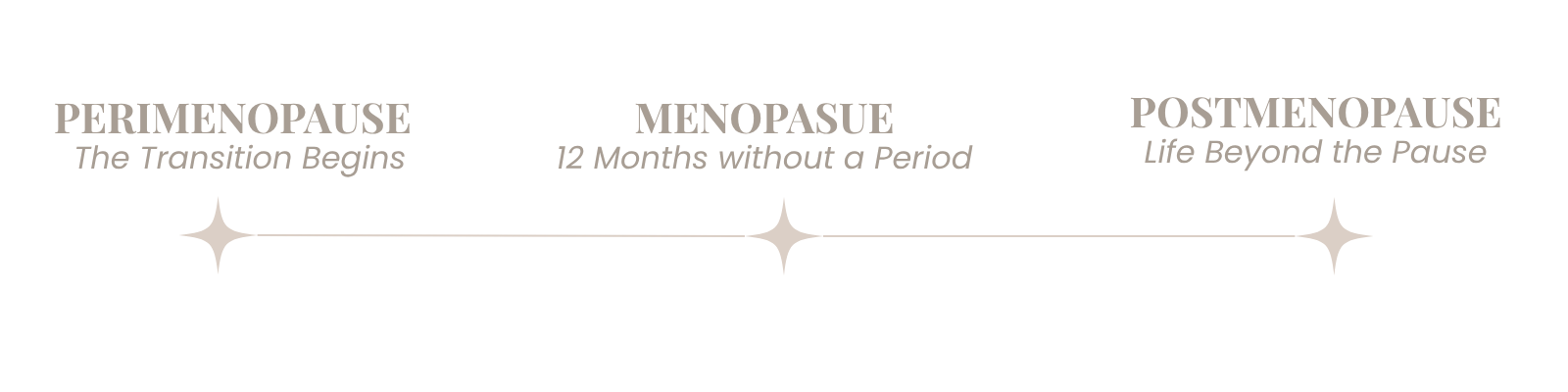
🌙 The Stages of the Menopause Transition
Many people use the word "menopause" as a catch-all term, which can be confusing. It’s helpful to understand the three distinct phases of this journey, as each has a different focus.
🌘 Perimenopause: This is the transitional stage. It begins when your ovaries start to gradually produce less estrogen, leading to hormonal fluctuations that cause the first appearance of symptoms. This chaos is why you may feel out of control or unlike yourself. Please know you are not imagining it. It is important to understand that you still have periods during this time, even if they are irregular, and pregnancy is still possible.
🌗 Menopause: This is not a phase, but a single point in time. Menopause is officially diagnosed after you have gone 12 consecutive months without a menstrual period. This milestone marks the end of your reproductive years.
🌕 Postmenopause: This phase begins the day after you have officially reached menopause and lasts for the rest of your life. While many symptoms like hot flashes may lessen over time, this is a critical period for focusing on long-term health, particularly bone health and heart health.
✨ The Science: The natural decline in estrogen removes a key protective element your body relied on for decades to help manage cholesterol and slow bone loss. This makes proactive care for your heart and bones a new and essential priority.
👉 Key Takeaway: Menopause is a single day. The “journey” and the “symptoms” are what you experience before (perimenopause) and after (postmenopause).
📚 Want to learn more? Read Perimenopause vs. Menopause: Understanding the 3 Stages of the Transition
⏳ The Perimenopause Timeline: When It Starts & How Long It Lasts
One of the most common questions women have is about timing. The truth is, the perimenopausal journey is unique to each individual. This variability can feel confusing, but it’s a normal part of the process.
When Does Perimenopause Start? The question of perimenopause age is one of the most common sources of confusion — and self-doubt. It typically begins in your 40s, but it's not uncommon for it to start in your mid-to-late 30s. If you're younger than 40 and recognizing these patterns, you are not too young and you are not imagining it.
How Long Does Perimenopause Last? This is one of the most searched questions women have when they first recognize the transition — and the honest answer is that it varies significantly. On average, perimenopause lasts about four years, but for some women it can be as short as a few months or as long as a decade. Understanding this range helps set realistic expectations without unnecessary alarm.
⏩ Accelerated and Induced Timelines
While most women experience a gradual transition, some face menopause on a different timeline.
Early & Premature Menopause. Menopause that occurs between the ages of 40 and 45 is considered "early," while menopause before age 40 is "premature." This can happen for a variety of reasons, including genetics or autoimmune conditions.
Surgical Menopause. This occurs when both ovaries are surgically removed (a bilateral oophorectomy), causing an immediate and often intense onset of menopause. This is not a gradual transition but an abrupt hormonal shift that requires a different kind of support.
👋 Perimenopause Symptoms Checklist: The Obvious Changes & Sneaky Signs
Think of this section as your perimenopause symptoms checklist — a way to recognize patterns that are easy to dismiss or misattribute when you don't yet know what to look for.
The early stages of perimenopause often whisper before they roar. Many women expect hot flashes to be the first sign, yet the earliest changes are often far more subtle. Recognizing these patterns early can help you respond with understanding rather than frustration.
⚠️ The “Hallmark” Signs
Changes to Your Menstrual Cycle. For most women, this is the #1 sign. As ovulation becomes more unpredictable, hormone levels, particularly estrogen and progesterone, fluctuate. These shifts may cause:
Changes in Cycle Length (longer or shorter)
Changes in Flow (much heavier or significantly lighter)
Skipped Periods
Worsening PMS: Has your familiar premenstrual week become a storm of heightened emotions and physical discomfort? The hormonal chaos of perimenopause can turn your typical PMS symptoms up to maximum volume, leading to heightened irritability, breast tenderness, and fatigue.
🕵️♀️ The “Sneaky” Symptoms That Cause the Most Anxiety
A woman's search for "perimenopause" is often prompted not by an irregular period, but by terrifying new symptoms she doesn't associate with menopause. Your fear is not just "in your head"—it's a real, physiological response.
Early perimenopause symptoms are frequently mistaken for stress, thyroid issues, depression, or simply ‘getting older,’ which means many women spend years confused and unvalidated before they get answers. Hormones affect nearly every system in the body, so early perimenopause can show up in many ways beyond your cycle. You might notice:
😶🌫️ Brain Fog. You may feel like you cannot find your words or remember names — privately questioning whether something more serious is wrong. It almost certainly isn't. Perimenopause brain fog is one of the most frightening and most commonly misattributed early symptoms. Hormonal fluctuations, especially in estrogen, impact neural pathways affecting cognitive function and memory. This is very common and typically temporary. Explore our approach to Brain Fog
😩 New Anxiety. Do you feel a sense of dread or panic for no reason? Feel like you’re constantly irritable? Estrogen and progesterone play a key role in regulating calming brain chemicals (like serotonin and GABA). When these hormones fluctuate, it can unmask or create anxiety. Explore our approach to Perimenopause and Mood
🫀 Heart Palpitations. Generally a feeling that your heart is suddenly racing, pounding or skipping a beat leading you to ask if this is a heart attack. Fluctuating estrogen can affect your autonomic nervous system, causing a racing heart. While this must be evaluated by a doctor, it is a very common and often benign perimenopausal sign. Explore our approach to Heart Palpitations
💪 Achy Joints. Questioning whether you have arthritis because your knees, shoulders and fingers ache every morning? Estrogen has a natural anti-inflammatory effect and helps protect joint tissues. As levels decline, you may feel new or worsening inflammation and aches. Explore our approach to JointPain & Stiffness
😴 Sleep Issues. This is often one of the very first signs. It can be caused by hormonal shifts or be the result of night sweats (even if you don't wake up drenched). Explore our approach to Sleep Disturbances
⚖️ Weight Gain. Diet and exercise haven’t changed, but you’re still gaining weight? As estrogen declines, your body's fat storage patterns can change, shifting fat from hips to the abdomen. This is often combined with age-related muscle loss, which slows your metabolism. Explore our approach to Weight Changes
👉 Key Takeaway: While these symptoms can feel confusing, they’re often your body’s way of signaling that its recalibrating, not breaking down.
💡 Do these symptoms sound familiar?
If you're recognizing yourself in this section — the sleep changes, the mood shifts, the brain fog that came out of nowhere — our free symptom quiz helps you make sense of your personal experience and gives you a starting point that's specific to you.
It takes under a minute. [Take the Free Quiz →]
This quiz is for educational and general wellness purposes only. It is not a clinical assessment or substitute for medical advice.
🦄 Debunking Common Myths About Perimenopause
Misinformation about perimenopause is everywhere. Let’s separate fact from fiction so you can approach this stage with clarity.
❌ Myth: “It’s all about hot flashes.”
✅ Fact: While up to 80% of women experience hot flashes, perimenopause affects nearly every body system. As we saw in Section 3, mood, memory, joints, and sleep can all shift first.
❌ Myth: “You can’t get pregnant during perimenopause.”
✅ Fact: As long as you’re having any periods, even irregular ones, ovulation can still occur. Pregnancy is still possible and contraception should be discussed with your provider.
❌ Myth: “Menopause means unavoidable weight gain.”
✅ Fact: Hormonal changes can alter where fat is stored (often moving to the abdomen), but weight gain is not inevitable. Lifestyle, nutrition, and stress management play a much larger role than hormones alone.
❌ Myth: “Hormones are dangerous for everyone.”
✅ Fact: Modern research shows that hormone therapy (HT) can be safe and highly effective for many women when personalized and monitored. This fear often stems from outdated interpretations of a major study from the early 2000s. For the right person, the key is individualized care—not fear. Individual suitability varies significantly based on personal and family health history. This is not a medical recommendation — discuss hormone therapy with a qualified healthcare provider.
❌ Myth: “You just have to ‘push through’ menopause.”
✅ Fact: This transition deserves care, not endurance. Supportive nutrition, movement, rest, and medical guidance can dramatically improve your quality of life.
📚 Want to learn more? Read 10 Common Menopause Myths Debunked with Science
🌿 Ready to move from understanding to action?
The Find Your Cool 3-Day Reset is a free, focused starting point designed to support women navigating the early disruptors of perimenopause — blood sugar stability, nervous system calm, a cooling method, and a sleep upgrade.
Three days. Four stabilizers. A foundation your body may notice. [Download the Free Reset →]
The Find Your Cool 3-Day Reset is for general wellness support only and is not intended as medical treatment. Always consult your healthcare provider about your specific symptoms.
🛶 Navigating Your Health: Why Your Symptoms Are Your Most Powerful Tool
The perimenopause journey is a powerful invitation to become a more engaged advocate for your own health. But many women feel their symptoms are dismissed or minimized, which can be deeply frustrating. Often, this frustration stems from a single misunderstanding: the "blood test" dilemma.
👩⚕️ Why Your Doctor Won't Order a Hormone Test
You may feel confused or "gaslit" when you describe your symptoms and your doctor doesn't order a blood test to confirm them. It is critical to know this is not because your symptoms aren't real; it's because hormone tests for perimenopause are scientifically unreliable.
Your hormone levels can be "normal" on a Tuesday and "postmenopausal" on a Friday. A single blood test is a snapshot of a process that is a movie.
📝 Your Symptom Tracker: The Most Accurate Test You Have
There is no single definitive test for perimenopause. A diagnosis is correctly based on:
Your Age
Your Menstrual History
Your Symptoms
This is why your lived experience is your most important data. Tracking your symptoms in a journal is the single most effective way to see patterns and provide your doctor with a clear, concrete picture of what you’re going through.
This simple act can transform a frustrating conversation into a productive partnership.
💡 Tip: Track your top 5 symptoms daily for at least one month. Patterns will tell your story better than a single lab test ever could.
🌿 Want a structured place to start?
Our free symptom quiz walks you through the key patterns that matter — and gives you language you can actually bring to your next appointment. Based on your responses, it helps you explore where you might be in the transition and what your body may be asking for. [Take the Free Quiz →]
For educational purposes only — not a clinical assessment.
🩵 A New Chapter of Self-Awareness
Perimenopause is not an ending or a disease to be cured. It is a natural, powerful transition that marks the beginning of a new chapter. By understanding the changes happening within your body (from the “sneaky” symptoms to the new focus on long-term health), you can meet this journey not with fear, but with knowledge, self-compassion, and the right support.
🌿 Your Next Step — Two Ways to Begin
You now understand what perimenopause is, when it starts, what the symptoms feel like, and why your experience is real, not imagined, not dramatic, not "just stress."
The next step is turning that understanding into action. Two simple options — start with whichever feels right:
Option 1 — Make Sense of Your Symptoms: Our free symptom quiz helps you explore your personal pattern based on your responses — giving you a starting point that's specific to you, not just menopause in general. Take the Free Quiz →
Option 2 — Start Feeling Steadier Tonight: Download the free Find Your Cool 3-Day Reset — a simple, focused plan that addresses four of the most common early perimenopause disruptors in three focused days. Download Your FREE 3-Day Reset →
Both resources are free and for educational and general wellness purposes only. They are not substitutes for medical advice or clinical care. Always consult a qualified healthcare provider about your specific symptoms and health history.
Explore Our NovaGuides
Sources
The insights in this guide are drawn from leading experts and evidence-based resources to help every woman make informed, confident decisions about her hormonal health.
Key References
Cleveland Clinic. Perimenopause: What to Expect as You Approach Menopause. Updated 2025.
Mayo Clinic. Perimenopause: Symptoms & Causes. Updated 2025.
The Menopause Society. Understanding Perimenopause. 2025.
Office on Women’s Health (U.S. Department of Health & Human Services). Menopause Symptoms and Relief. 2025.
National Health Service (NHS). Early or Premature Menopause. 2024.
Royal Free London NHS Foundation Trust. Surgical Menopause. n.d.
UPMC. Menopausal Symptoms and Cardiovascular Disease Risk. 2016.
This page has been written and fact-checked by the NovaPause Editorial Team
Last updated January 2026